Research / Product strategy / Product design
Vera, a platform that seeks fair access to housing by connecting tenants and owners anonymously and based on objective criteria
Project
Vera
Role
Product Designer
Project type
Academic
Year
2025
My role
I was involved across key project stages: research, insight synthesis, ideation, information architecture, UI design, prototyping, and validation, using AI tools to support the process.
1. Overview
Context and problem
During our UX/UI Master's program, we focused on the Spanish rental market after identifying a system run on distrust and opacity: tenants compete for housing under pressure, while owners decide based on intuition and prejudice: two disconnected sides instead of a balanced exchange.
Solution
Vera connects tenants and owners anonymously through verifiable, objective criteria such as solvency and affinity, removing discrimination and emotional strain from the process.
2. Research
HIGHLIGHTS
6 insights revealed the core problem wasn't economic but emotional and systemic: lack of communication, disguised discrimination, and the need for representation.
Qualitative and quantitative methods
We combined desk research on housing legislation, discrimination studies, and the Spanish rental market since 2020, with 12 interviews (tenants from diverse profiles and 2 real estate professionals) and 59 surveys to validate patterns.
Who are we designing for?
Based on interview data, we defined two User personas representing both sides of the market:
Marc (30): Independent renter.
Miguel (49): Inherited homeowner.
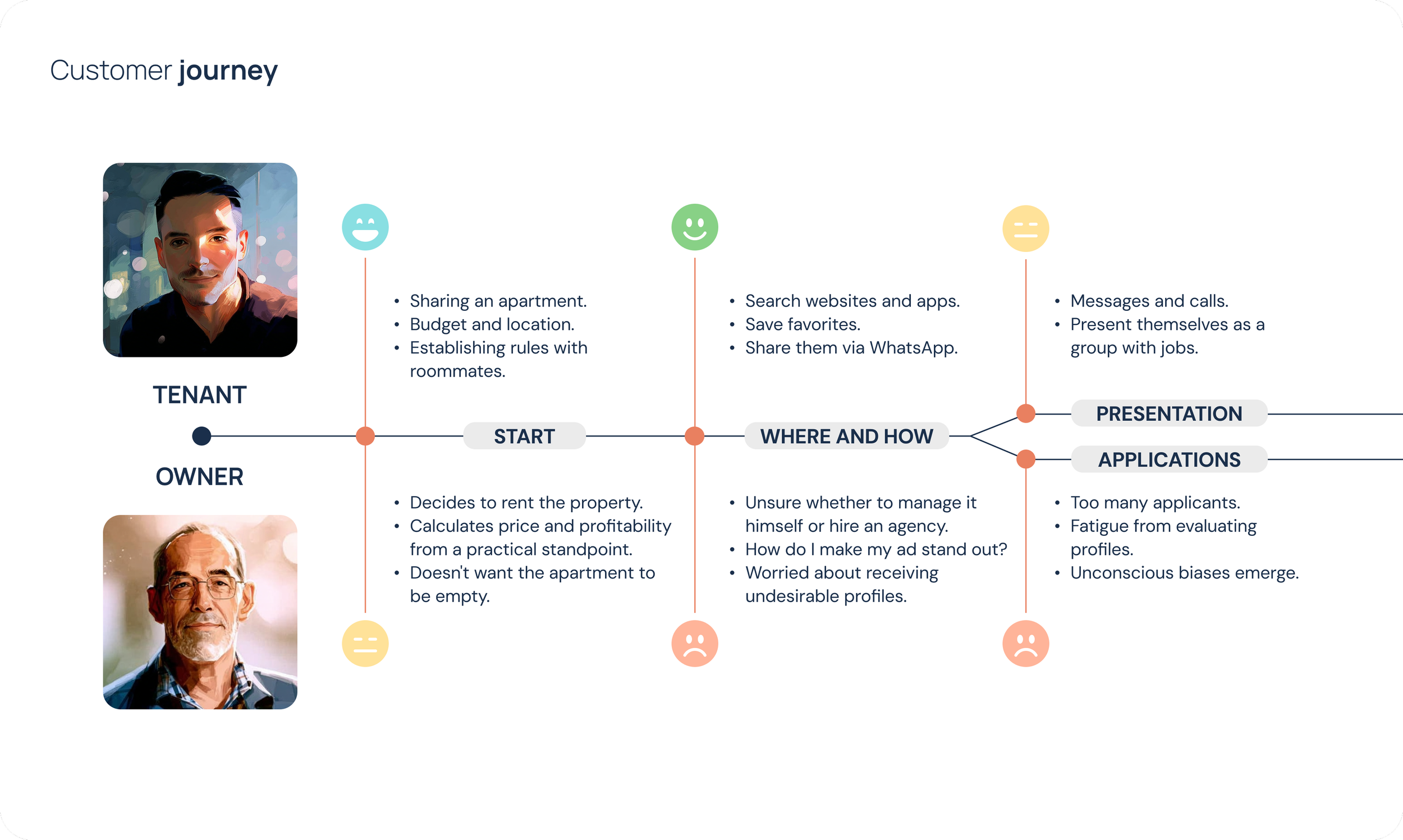
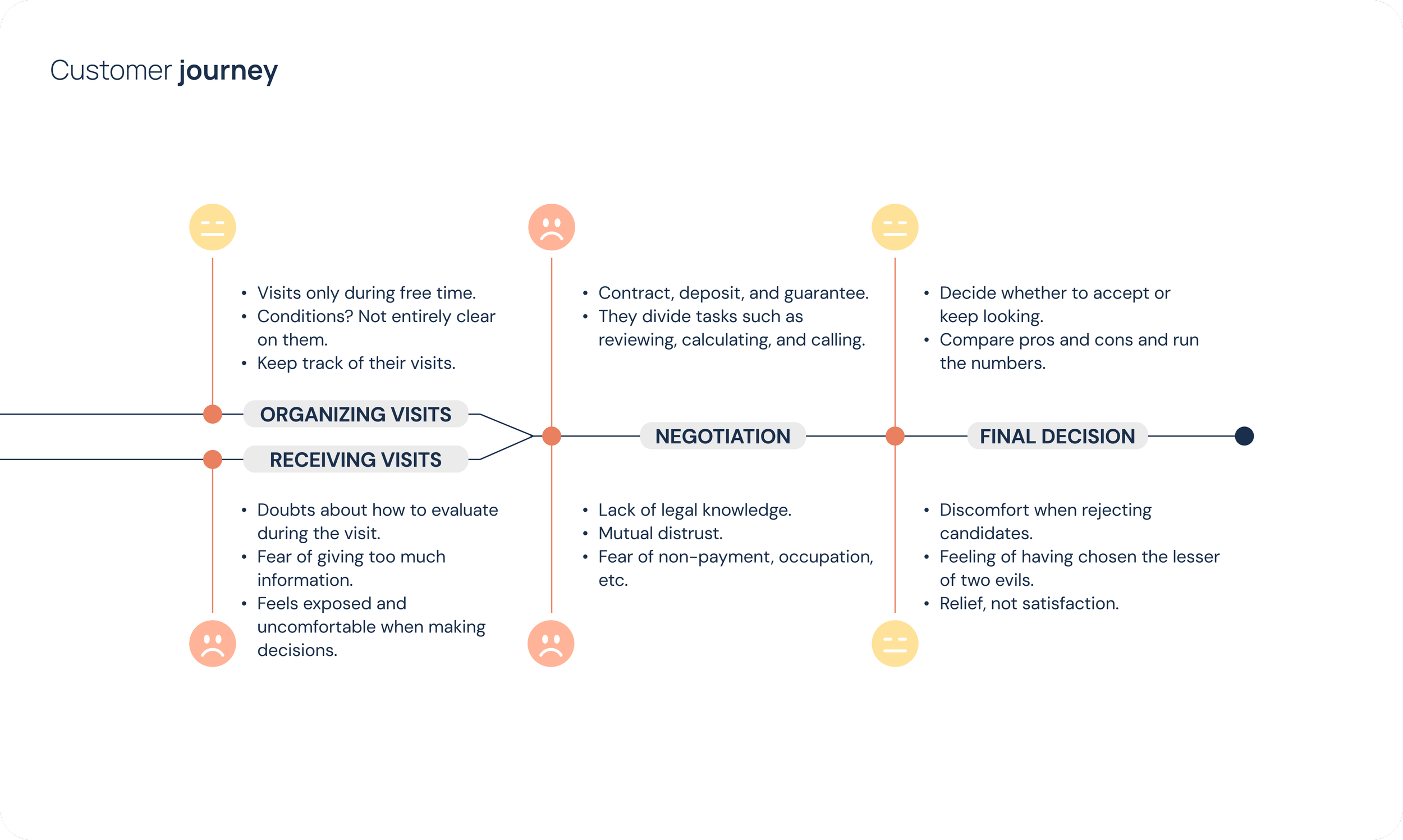
To understand their pains and gains, we created Empathy maps, and mapped the full Customer journeys of both profiles.
6 insights transformed our approach
After synthesizing research data and user stories, we identified six key insights that reshaped our understanding of the problem.
1. Emotional exhaustion is the real problem
Uncertainty, silence, and lack of feedback generate anxiety that affects mental health.
2. Discrimination is systemic
The system pushes the owner to make decisions based on intuition and fear: occupation, non-payment, or legislative changes.
3. Total lack of communication
Tenants never know why they were rejected, leading to paralyzing helplessness.
4. Economic requirements are a form of disguised discrimination
It doesn't guarantee anything, but it's the only filter, excluding people who could be excellent tenants.
5. Lack of legal information
Most tenants are unaware of their rights and sign contracts without advice because they don't know where to find clear information.
6. Discriminated groups need representation
They want someone to defend them against market distrust. They seek emotional support, not just transactional support.
What solutions are available on the market?
A competitive benchmark identified two clear patterns:
Existing platforms in the real estate industry heavily protect owners.
Tenants are the most vulnerable actors, with little protection or decision power within the system.
3. Product strategy
HIGHLIGHTS
Chosed 5 guiding pillars (anonymity, objective criteria, transparency, ethical validation, user-centered experience) and scoped the MVP down to 3 flows via MoSCoW.
It's not an economic problem, it's systemic
If the conclusion is that the problem is systemic, Vera's goal must be to rebuild that bridge between both sides by connecting facts, not prejudices.
Using How Might We (HMW) questions, we defined 5 core pillars that guided every design decision:
1. Anonymity
Neutral avatar, anonymous data until the time of the visit. Protects against discrimination.
2. Objective criteria
No intuition, no bias. Verified solvency, calculated compatibility.
3. Transparency
Constant feedback, visible status, two-way communication. No more ghosting.
4. Ethical validation
Proof of solvency from the moment of registration. Fair ethical conditions from the start.
5. User-centered experience
Predictable and humane process, without unnecessary friction.
Our value proposition
We connect tenants and owners anonymously, based on objective criteria such as solvency and affinity, to make the rental process fair, efficient and free of discrimination.
Business viability
Vera's business model relies on two complementary revenue streams:
Owners pay a reduced commission: 50% of the first month's rent (significantly lower than traditional agencies) to lower entry barriers and scale through volume, not exorbitant prices.
Tenants have 3 free initial visits, followed by a symbolic micropayment that filters genuine intent and reduces friction for both parties.
The result is a fair, efficient, and scalable system where ethics are embedded in the business model.
What is essential for the MVP?
We developed a User Story Mapping for both profiles, identifying all the necessary tasks, then prioritized features using a MoSCoW framework.
Given the limited time, we had to choose the most essential features, resulting in an MVP focused on 3 core flows that cover a full user cycle.
Owner
LIST THE PROPERTY
Tenant
CRITERIA FOR
IDEAL HOUSING
Tenant
MATCHING AND
SCHEDULING A VISIT
4. Information architecture & user flows
The user journey through the platform
We designed User flows for the 3 core features, covering the full journey from first entry to the outcome: a list of compatible homes and the option to request a visit.
From there, we structured the platform's information architecture with the two different users in mind. This challenge became our ally, compelling us to simplify, unify and eliminate tasks we initially considered essential, like appointment scheduling between users, reassurance messaging, and profile validation.
Validating the architecture with real users
Card sorting and Tree testing with real users led to key changes:
Users thought in concrete contexts, not abstract categories: "Profile, where my data lives," "Properties, where I see options," "Calendar, where I see my appointments."
Merged profile creation and validation into a single step.
Turned "compatibility" into an actionable step: "Schedule a visit."
Removed the “ideal tenant” definition to prevent bias and discrimination.
Designing with cognitive biases in mind
Paradox of choice: Instead of displaying 500 properties, we only showed the truly compatible ones.
Progressive disclosure: We presented the questions step by step, instead of lengthy forms.
Jakob's Law: We prioritized the use of familiar patterns.
5. Design
The identity of ethics
We created a visual identity focused on transparency and approachability:
The name Vera comes from veraz (truthful): a promise of transparency in an industry where trust is key.
We chose friendly illustrations over stock photography to humanize the interface and put people at the center.
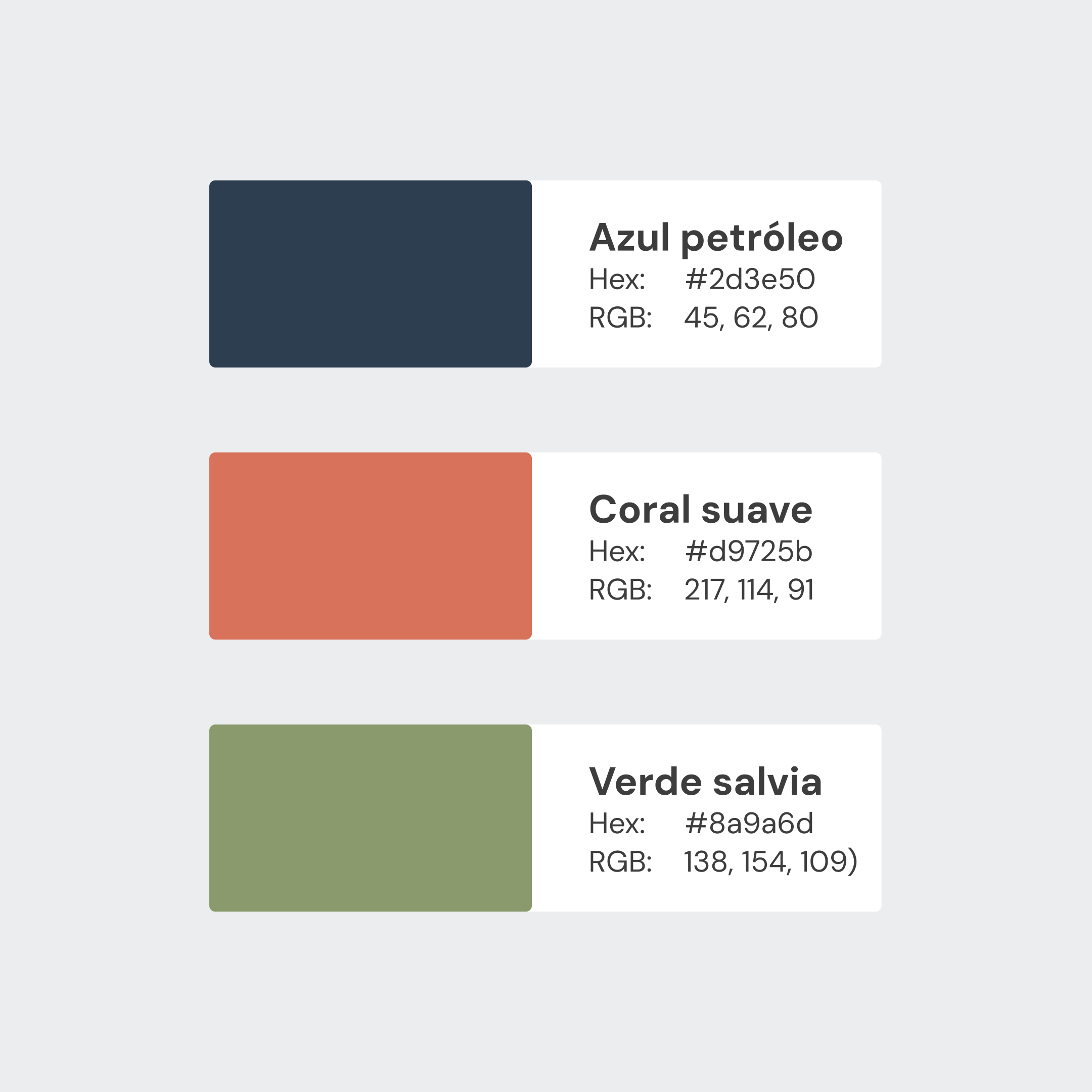
The color palette conveys calm and confidence, avoiding institutional coldness during a sensitive process.

What does the user feel when using Vera?
Users arrive with doubts and limited information, so we reinforced trust through microcopy and clear feedback at every step.
For example, when scheduling a visit, we eliminate uncertainty with a direct message: "You are the 6th person to visit the property, and you will receive the exact location 24h before."
6. Prototyping
3 prototypes that complete a full cycle
With the foundation defined (branding, system, usability and accessibility), we designed three prototypes in Figma:
Prototype 1: Home (Tenant)
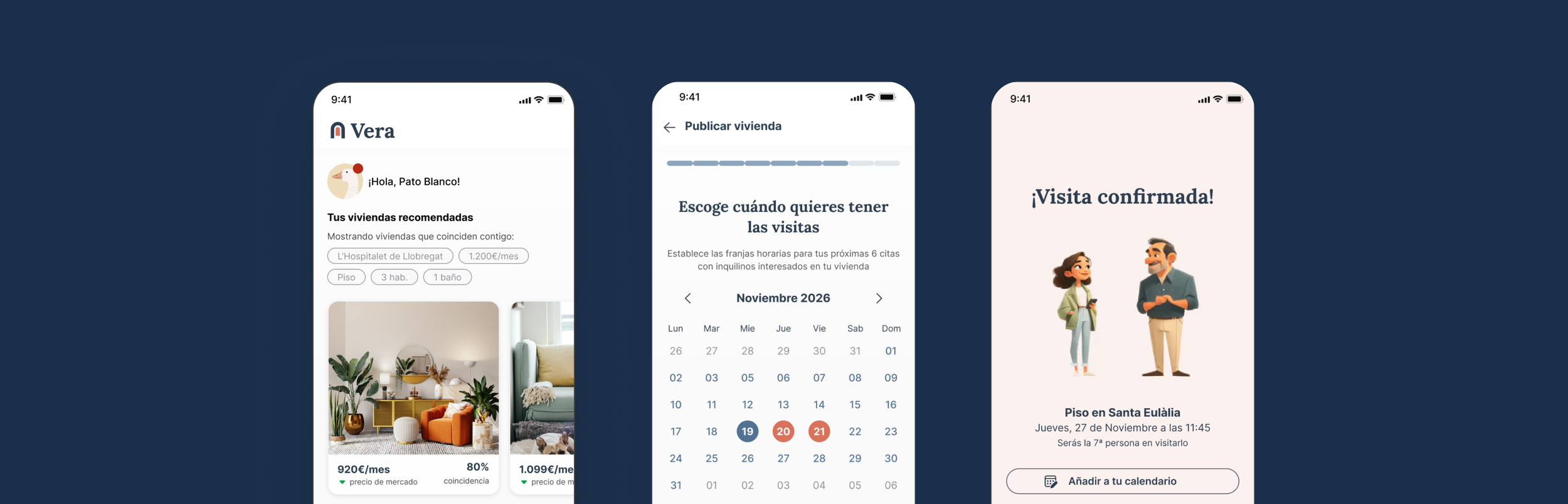
The tenant home features an anonymous profile, property suggestions based on key characteristics, and direct access to the core feature: Explore.
Prototype 2: Listing a Property (Owner)
A guided, sequential listing workflow for owners: property details, photos, and document verification, concluding with scheduling and confirming visits.
Prototype 3: Housing criteria and scheduling a visit (Tenant)
The tenant defines their ideal home just once. The system then displays only matching properties, with complete listing information and calendar-based visit management.
7. Validation
Continuous testing
Validation was ongoing throughout the project, not a final step. Final User testing with 8 users validated our hypotheses but also revealed real pain points::
5 out of 8 users looked for the neighborhood of the property in the Explore section, so we added it.
6 out of 8 users had difficulties with the calendar and selecting times, so we redesigned it.
8. Road map
Vera's future
Phase 1: completed the MVP's core features.
Phase 2: expand with tenant/owner recommendations and AI-assisted decision-making and legal support.
Phase 3: integrate public verifiers to strengthen trust and improve the business model.
9. Final thoughts
Vera taught us that the best design isn't necessarily the prettiest or the most functional. It's the one that solves real problems while respecting user dignity. When design impacts people’s lives, it becomes a tool for social change.
My design tools
Notion
Figma
Mobbin
NotebookLM
Forms
ChatGPT

Condens